I DON’T KNOW WHAT TO DO…FIRST. Call and email my representatives demanding that they grow a spine and stand up to the madness in DC; prep for my African-American studies film class; cook dinner for one of my friends displaced by the fires; listen to the news; turn off the news; meditate; reach out to my trans friends letting them know I am with them… It all seems both futile and crucial at the same time. So today I’ll write my blog. Because Black history is what I do, and February is called Black History Month, and there is never a wrong time to share some Black history – especially in the midst of the madness that is our government right now.
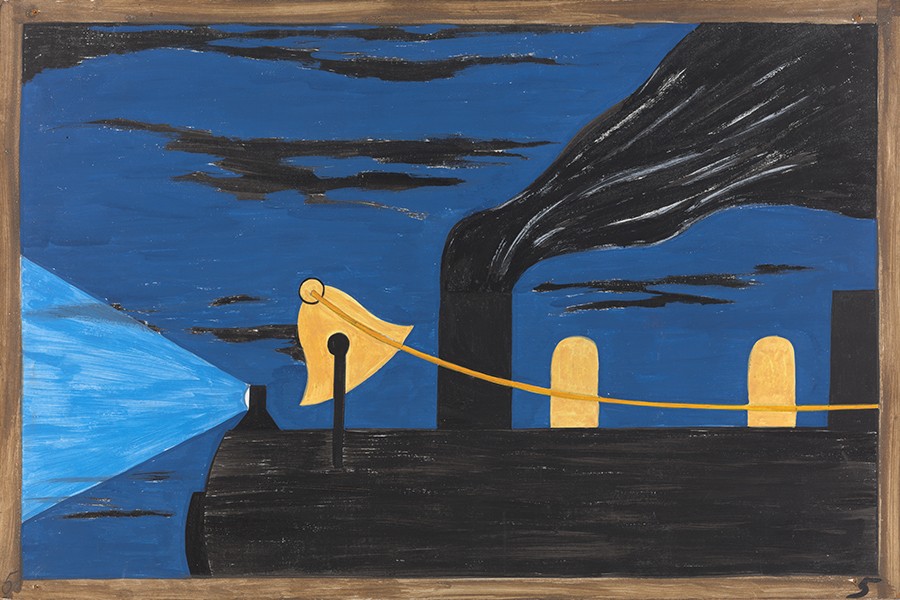
“Migrants were advanced passage on the railroads, paid for by northern industry. Northern industry was to be repaid by the migrants out of their future wages.”
As Jacob Lawrence captions this painting, Southern migrants were sometimes advanced train fare by employers in the North as incentive to migrate to new jobs. Now, no one in the Krueger-Scott African American Oral History Project, upon which my book Alien Soil is based, mentions these advances specifically. Then again, there was no question asking the narrators how their travel was paid for. But when you read my book, you will get to meet all sorts of folks who, in one way or another, benefited from someone in the family taking that train out of the South.
That said, this was most certainly a practice. And it is a practice that some compare to sharecropping, wherein African Americans were also advanced something — often land, farming supplies, a house… Unfortunately, when it came time to repay these advances, Black Americans were often met with inflated numbers and unscrupulous fees. And because good ideas travel fast, this practice was also mirrored when new migrants were provided the chance to purchase staples “on credit” in Northern urban stores, only to receive excessive and/or inaccurate bills at the end of each month. And so it went. Throughout American history white people have offered all sorts of “advances” to African Americans and the working poor, from giving enslaved workers jobs in the master’s house, to today’s check cashing stores, and there has most always been a catch.
According to the Schomburg Center for Research in Black Culture, train fares cost about 2¢ per mile in 1915, doubling in price just three years later. That was a lot of money for someone living in the South, working for someone else and receiving minimal compensation. It is approximately 620 miles from Florence, South Carolina – where Madam Louise Scott was probably born – to Newark, New Jersey. So that train ticket would have cost around $12.40. How might that stack up alongside a sharecropper’s income? (Now of course, not all migrants from the South were sharecroppers, but it was one of the handful of occupations made available to African Americans post-emancipation, so it is a good general measure in terms of cost ratios).
The total income of sharecropper families in Laurens County, S. C., averaged for the year 1937 only $285, including $214 advances and sums owed at the ‘settlement’ date, and $71 cash paid on that date. In Florence County, S. C., the advances made by the landlord and owed by the sharecropper plus the cash settlement paid to the sharecropper was on the average $329.
“Farm Labor,” Monthly Labor Review, Vol. 51, No. 5 (NOVEMBER 1940), pp. 1151-1155
So if Madam Scott’s family were sharecroppers, hypothetically, one ticket to Newark would cost about 4% of their annual income. And most of that “income,” mind you, had already been spent or promised to the landowner. This is why, quite often, only one person from the family would head out initially, earn some money and then send it back for others to follow. Other migrants sometimes made the journey in stages, stopping off and working in places along the way to their final destination. Occasionally one of those stops ended up being the final destination. This “step migration,” as termed by the Schomburg, would take a long while. In one interview Jacob Lawrence himself recalled that his family was:
…moving up the coast, as many families were during that migration…We moved up to various cities until we arrived – the last two cities I can remember before moving to New York were Easton, Pennsylvania, and Philadelphia.
The labor agents went down South with these offers of cash advances, but not without resistance from the Southerners. After all, they were stealing away cheap labor right out from under them. These agents met with many obstacles, thrown at them in myriad ways – from station agents simply denying the provided train passes to arresting the labor agents. Lest we think these Northern agents were somehow representing benevolent industrial entities, they too were in search of relatively inexpensive labor, offering carrots on sticks in the form of these cash advances. And, echoing the times of slavery, only the healthy and strong were typically made these offers.
In 1916, Newark held a famous industrial exposition, celebrating the 250th anniversary of its “settlement.” People from around the country attended, including the president of the United States, Woodrow Wilson. Newark’s industry was robust, to say the least. From famous breweries like Ballantine and Krueger, to factories that made spring shade rollers from wood and tin for cars and porches, to the Central Foundry’s cast iron pipes and fittings, the Industrial Revolution was an explosion of production. These companies needed people willing to go into their factories and work under often subpar conditions. There are wretched tales of these environments, including what it was like to work in one of Newark’s most famous industries, the leather tanneries. But folks were poor, and these jobs offered pay that most had never come close to in agricultural work, or other types of labor in the South available to African Americans.
And so they came. And they stayed. And their families came, too. And after a long hard while, they made themselves at home in cities around the country. Cities like Newark, Detroit, St. Louis, Pittsburgh, Cleveland and even Los Angeles are what they are in large part because of this Great Migration. And thus we just must keep on learning our history, despite the Herculean efforts of so many in political power right now. Because, for one thing, Black history is American history.
 Katie Singer
I never thought about how the migrants may have paid for the train fare to leave the south. Advancements! Dangling the carrot and the stick. As a child, my parents told me about the train ride to California from Louisana and Texas. I wondered if they came because of fare advancements? Thank you again, Katie, for helping to put the puzzle pieces together to answer some questions that we didn’t think about asking when the story was told.
LikeLiked by 1 person