BLACK WOMEN ACTIVISTS still don’t get enough play in our country’s historiography. But slowly their stories are being foregrounded, such as in my colleague Hettie Williams’ new book, The Georgia of the North: Black Women and the Civil Rights Movement in New Jersey.
My recent book, Alien Soil: Oral Histories of Great Migration Newark also foregrounds the stories of these activists, in their own words. In sharing these stories, I argue for an expanded definition of the word, activism, itself. My hope is that this in turn will provide increased light on the subject of “everyday” people doing the good work, making the good trouble.
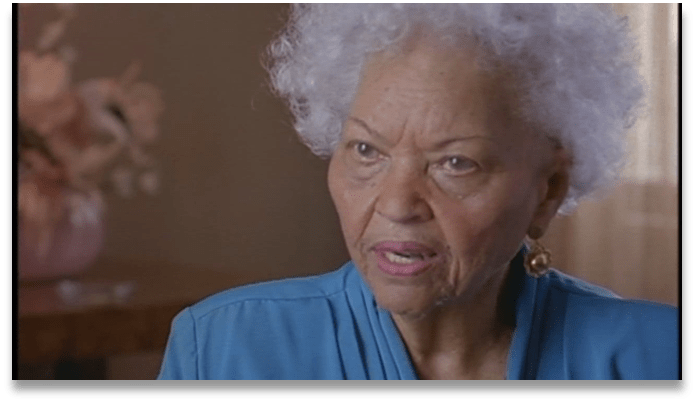
Today’s blog is dedicated to just such a woman, a participant in the Krueger-Scott African-American Oral History Project who is featured in my book. Allow me to introduce one of my favorite people, Louise Epperson.
Louise Epperson was born in Waynesboro, Georgia in 1908 and moved to Newark, New Jersey in 1932. She worked as a domestic, one of the few jobs available at the time for Black women. Epperson was living what she called “a quiet life” at her aunt’s house on Orange Street, and later on down the line saved up enough money to purchase a modest home of her own on 12th Avenue.
She ultimately secured a position as an aide at the Willowbrook State School on Staten Island, a facility for the mentally disabled. Once hired, she started eyeing the occupational therapist position but was told that a Black woman would never be hired for the relatively prestigious job. Yet she persisted.
And I bidded on that job and I got the high score and I received it and I was the first Black to work on that. I was the first Black to work in occupational therapy. Everybody say when I saw that on the board, “Oh Mrs. Epperson they don’t hire no Blacks.” And I say, “You don’t know what they’ll hire until you try.”
Her plan was to retire from Willowbrook in 1967, going back to that quiet life of her early years. That was until a newspaper headline changed those plans. On January 1, 1967 she read in her morning paper that the New Jersey College of Medicine and Dentistry (NJCMD) was planning to expand right into her own backyard:
It said that this school was gonna move into Newark regardless of what anyone said, and they were coming from Jersey City because they was runnin’ Jersey City broke. So they were going to come into Newark, and first thing they were gonna do was to blight all the land that they wanted. And they wanted something like over 300 acres of land at that time. And they had already blighted part of 12th Avenue where I lived, and one side of the street was blighted. And they called that urban renewal. Well I say it looks more like Negro Removal than urban renewal, you know.
This was just one more land grab that was happening to urban neighborhoods across the country at the time. The official name of this act, “eminent domain.” But Epperson wasn’t having it. Starting out with meetings at her kitchen table, attended by just a few neighbors, Epperson ultimately founded the Committee Against Negro and Puerto Rican Removal, a group that would become a cornerstone of Newark’s political history. It is probably clear by now that this is not the story of some unwitting woman caught up by the winds of a turbulent historical moment — a trope regularly perpetuated upon women of color, especially. Rather, this is a tale of yet another longtime feminist activist of color, a household name in her community, who is scarcely acknowledged in the history books.
People had already started moving out of Louise Epperson’s 12th Avenue neighborhood. Some did so in order to remain one step ahead of what was presented by the media and municipality as a fait accompli. It was in the middle of all this that the July 1967 rebellion erupted:
When I started the fight with the med school, I tried to get everybody in the city and the state and the county and the federal government to help me. I went to everybody. Everybody gave me the runaround. To go to this one, and go to that one . . . I had contacted everyone that I possibly could in higher, upper powers. Then the riots broke out. Everybody that I tried to contact before this happened, everyone, everyone, including the Governor, including the president from the College, Dr. Cadmus, including Chancellor Dungan, Paul Ylvisaker, they all came to my door to see what they could do to sit down for a community meeting in the City of Newark.
The Governor ended up sending two buses to Newark, inviting Louise Epperson and her comrades to ride down to Trenton and talk with him about the development plan. Other leaders simply asked Louise Epperson to “call them off.”
I said, “I can’t call them off, I didn’t call them on… You know, you did that not me. You called the State Troopers in here. You barbed-wired our city off where nobody could come in or go out. I didn’t do those things. You did it. And people are dead, and I’m feeling very sad and very low because it could have been avoided if you’d have only took time to meet with me. I was willing to come any place to meet with you so that we could settle this thing before it got this far, with all the dead people and the hospital.”
Louise Epperson, along with a number of other groups and individuals, organized, mobilized, and battled against political and administrative powers — from municipal to federal — for many years. The outcome of this long and drawn-out fight was the Newark Agreements. This plan included a decrease in the hospital’s land allocation which would have initially displaced approximately 20,000 Black and Puerto Rican residents in the Central Ward. There was a moderate increase in financial subsidy for those who would be displaced by the medical school development as well. Eventually the hospital was built on 58 acres, much less than the initially proposed 300 acres. In addition, 60 acres in nearby neighborhoods were to be “relinquished,” designated expressly for new and affordable housing.
In the end, of course, there were still numerous families who suffered under yet another relocation, but because of the work of Mrs. Epperson and other local activists, more people received better compensation than that which was initially promised. In addition, extra beds were designated at the hospital specifically for use by the local community, and gradually the medical school delivered on supplying much needed medical services — and a handful of jobs — to the residents of Newark.
Meanwhile, Louise Epperson received a job offer from the very hospital against which she had organized. The community encouraged her to take it, she said. This way she would be sure that the hospital kept its promises.
I went home, and I thought it over and I prayed on it. I decided to come to work for the College of Medicine and Dentistry — providing that I had an open-door policy: I could go direct to the President anytime I wanted.
Indeed, she was given full access to Dr. Cadmus and was seen marching into his office on a regular basis with issues brought to her by the community. Mrs. Epperson continued to advocate for her city until her retirement at age 87, and even thereafter. She passed away in 2002, at the age of 96.
Just one more example of why I say, “let’s keep learning our history!”
 Katie Singer
Wh
LikeLike