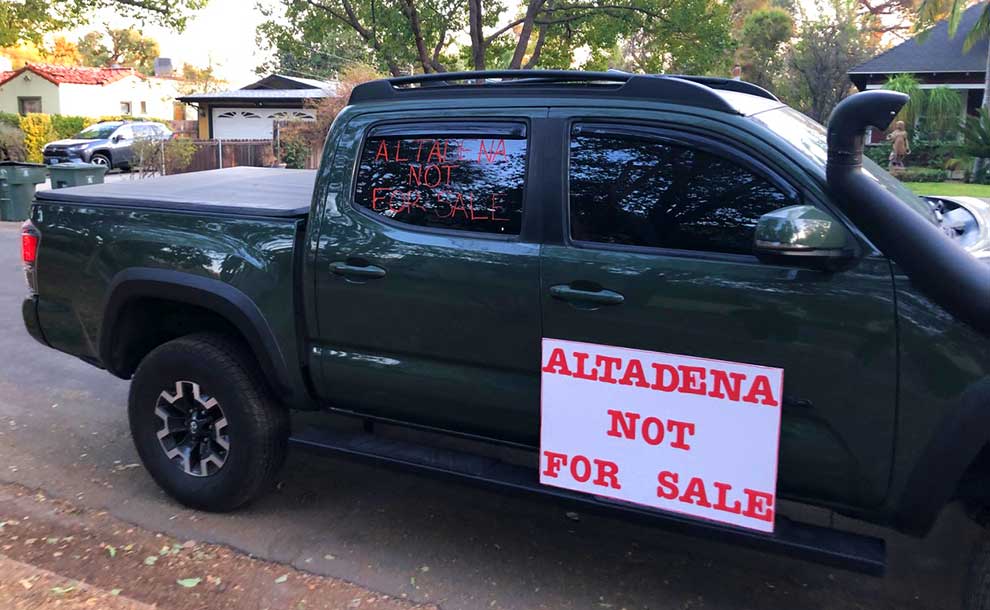
ALTADENA. A TOWN THAT HAS BURNED, BUT NOT DISAPPEARED. So many of us, in our own ways, plan to make sure in fact that Altadena does not disappear, does not go the way of Seneca Village in New York City, for example, or Morrisonville, Louisiana. There are still edifices standing here and there among Altadena’s ravaged streets. These physical structures may or may not remain. But the town’s presence must.
What always remains is the history. Yet sometimes that history seems to disappear on us, as if it too was a physical structure, capable of ruin. Actually though, the only thing that happens to these certain histories unheard is the erasure by those of us who have committed to foregrounding this country’s story. Sometimes selective memory – and selective distribution – can take hold. As an oral historian working in African-American history, that is a painful thought indeed — as it is to so many who have been living their lives in Altadena. They know the unknown histories, the towns that have fallen off the historical map. Because they heard tell of these stories, from a family member, a special book, a found photograph that prodded the onlooker to ask yet more questions. Yes, some folks know just how easily a place can go from thriving community to never-heard-of-again. Especially Black folks.
“Historically Black. Emerging Latino. All community. That’s my town, and the Eaton Fire can’t kill its spirit.”
– Rafael Augustin, “What Didn’t Burn in Altadena,” Mother Jones Magazine
So who is Altadena, you might ask, if you are unfamiliar with this incredibly special community. I won’t bother sharing my own personal relationships to it, as they are superficial compared to so very many others’. It is my hope to foreground those others’ stories soon. For now, I’ll provide a brief history to give context for the media reports you may or may not still be receiving if you are outside of Los Angeles. The news cycle turns quickly and without any more raging flames for the reporters to stand in front of, some have already moved on in search of the next crisis to cover.
Once upon a time, just after California received its statehood in 1850, Benjamin Eaton – after whom Eaton Canyon, the epicenter of this recent fire, was named — began developing water systems for owners of the 14,000 acre San Pasqual Rancho. This area eventually became Pasadena, South Pasadena, Altadena, and other adjacent communities. Even as the Great Migration, much like in Newark, New Jersey — and other cities around the country — changed the racial makeup of Los Angeles neighborhoods, there was still much resistance to that change. When African Americans did make it into Altadena, it tended to be on the west side of Lake Avenue. That bifurcation has yet to be fully dissolved.
Fast-forward to mid-century and Altadena is reportedly 96% white. The politically active era of the late 1960s and 70s changed that demographic somewhat, as did the phenomenon some still call “white flight.” This term is more complicated than those two words and deserves much more time than I will take here. The book, Popular Culture in the Age of White Flight might be helpful in that it concerns itself with the “rise of a new suburban consciousness in Southern California” – and is one of only a few books covering the west coast version of this shifting demographic trend.
This predominance of whiteness in communities was, of course, quite purposeful. Redlining (realtors sectioning off certain parts of a city from Black – and other “unwanted” – home buyers; plus, restrictive covenants which essentially had homeowners promising they would not sell their homes to Black people, were some of the effective measures in keeping things just as they had always been. A great book with a more granular look at these movements of whites (and others) from city to suburb, is Becky Nicolaides’ The New Suburbia.
There are so very many stories in Altadena, so many lives lived. But because of what has happened with a multitude of towns boasting a robust Black population, many of us are afraid that Altadena’s stories and lives might be forgotten due to this Eaton Fire that devastated miles of homes and businesses owned by African Americans in the community. You see, from Oscarville, Georgia where in 1912 a white mob threatened and perpetrated violence such that many Blacks fled – or were murdered; to 1921Tulsa, Oklahoma where the Black population was obliterated by fire from another white angry mob; to so many other Black towns destroyed by natural disasters, it is typically more difficult for these populations to rebuild, to replace that which they once owned. This has to do, most generally, with the deep systemic racism of our economy dating back to times of slavery.
So what to do? Well, folks from all over are answering that question with aplomb. People with financial knowledge are contributing their time to inform and support Black residents who want to try to stay in Altadena. “Altadena not for sale,” reads signs, t-shirts, and Instagram posts everywhere one looks these days. (Because the vultures are swooping in quickly). Then there are the contractors, volunteering their expertise as well, advising on how to rebuild safely, perhaps even more resiliently.
Me? Well, I keep working at my Pasadena food pantry, Friends In Deed which has served, and will continue to serve, so many in and around this area. But I am also hoping to initiate an oral history project in order to ensure that the people and their history remain front and center as this historically Black community resets. Because in the end we don’t really know what that reset is going to look like. But, if one glances back at similar moments in American history, there sure seems a strong possibility that things will not look the same as they once did when it comes to the racial – and economic – makeup of Altadena. So I am in the process of gathering other oral historians, and contacting stakeholders of this community. And when the time is right, we will aid in the town’s preservation efforts in our own little way.
As I write in my book based on the Krueger-Scott African-American Oral History Project, Alien Soil:
Fires are often featured in the oral folklore of a community, memories of disaster handed down through generations. [Veteran oral historian] Alessandro Portelli explains, “…oral narrators have within their culture certain aids to memory. Many stories are told over and over, or discussed with members of the community; formalized narrative, even meter, may help preserve a textual version of an event.” In the case of fires, this mode of memory preservation seems important as there is little in the way of recorded history when it comes to the many fires discussed by the Krueger-Scott interviewees.
And so it seems important to employ some memory preservation so that the history of beloved Altadena does not become yet another erased story in African-American history.
 Katie Singer
I
LikeLike