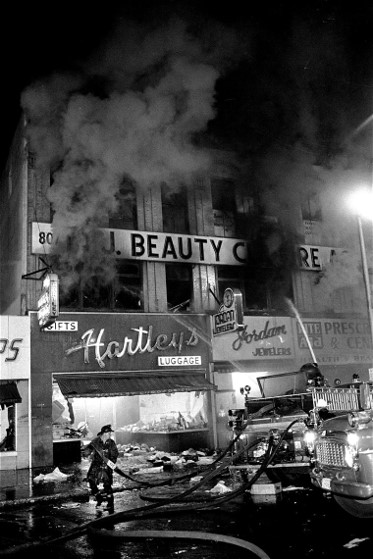
FIRE GETS SEARED INTO PEOPLE’S MINDS. The vision of fire, the smell, the heat… And even just the stories that include fire can often make deep inroads into the imagination. So much so, in fact, that some people even remember fires where there were none.
This is the case around the narratives of urban rebellion quite often. It is even a way, at times, for the media and other self-nominated reporters, to illustrate just how dangerous the city streets are for the average person. After all, our country has had a dysfunctional relationship with its cities since their inception, the issues typically centering around race and class. So if tales of burning buildings and flaming cars can get some people’s attention – and perhaps confirm the lack of civilization in these urban spaces – then why not light the narratives with fire, some think.
Another reason fiery images and tales are so effective is because a lot of city folk – especially poor and working class – have had to contend with fire on a personal basis. They know its all-consuming behavior and would prefer to never have to negotiate with it again. That was the experience of many of the Krueger-Scott African-American Oral History Project narrators who appear in my book, Alien Soil: Oral Histories of Great Migration Newark.
Coyt Jones was a postal worker in Newark, New Jersey – and the father of Amiri Baraka. He had arrived by train from Hartsville, South Carolina in 1927, at the age of 11. By himself. He was told to take a taxi from Newark’s Pennsylvania Station to a relative’s house when he got there. When asked in the interview about his trip north, he answered:
Jones: I don’t remember. There’s only one thing I can remember about that ride was the amount of people that crossed the street at Broad and Market. I had never seen that many people before.
Blount (interviewer): Were they African Americans or were they –
Jones: They were all people, mostly white I think. This was years ago, remember? I asked the taxi driver if there was a fire someplace. Where was all the people going!?
Jones apparently had also told his interviewer Mrs. Blount, when the tape recorder was off, that there was something he wanted to share on tape, a “significant incident.” Towards the end of the interview Mrs. Blount invited Jones to “go ahead” with the story. The incident in question concerned a fire Jones witnessed sometime around 1920, back in South Carolina. Jones and his family lived three houses down from the “Oil Mill Houses.” These were small company homes for the employees of the Hartsville Oil Mill which produced cottonseed oil. Jones recalled hearing that the rent was $2.00 to $3.00 per month.
One night an Oil Mill House caught fire, and ultimately the whole row of homes burned down. “The only thing standing in those houses was a chimney,” said Jones. His mother warned him not to go down to the site that night, but the young boy snuck out anyway:
I must have been about four or five years old. I don’t remember. Anyway, a lady got burned up in one of the houses, and she was still holding the baby to her bosom when she burned. She was layin’ on those springs and the bed and everything and the mattress was all burned up. I’ll never forget that. Never forget it. That’s one of the worse things I guess I’ve ever seen.
One might imagine that when the 1967 uprising began in Newark, and he was seeing flames – or being told that there were flames — that Mr. Jones may have been transported back to his childhood memory of his five-year-old self standing in front of the burned remains of a young mother.
Because of the efficacy of fire as a memory holder – and shaker – some of the conversations in the oral histories went from fire as the subject to fire as the fuel for further storytelling.
Glen Marie Brickus, one of the peer interviewers in the oral history collection, was born in Minden, Louisiana. Her father was a bricklayer there. Senator Wynona Lipman grew up in La Grange, Georgia and it turned out her father had been a bricklayer, too. She remembered her childhood with affection. “It was wonderful. We had a cow until the town made us get rid of it.”
She and Mrs. Brickus had a spirited exchange as they began comparing notes on growing up in the south. It all started when Mrs. Brickus asked a question about old folks using snuff:
Lipman: Oh, the snuff, yes. Snuff, the lady who helped us do the washing, at the wash pot outside, you know, where you boiled your clothes for washing over a fire. Oh, she was a snuff dipper I tell you. And my father chewed tobacco. Yes.
Brickus: Oh yeah. Yeah, we had one of those wash pots in the backyard. And somebody had to go and build a fire on the wash day.
Lipman: I remember killing pigs, too. And making crackling.
Brickus: Oh really? Yeah, we did too, we did too.
Lipman: We had chickens, and all of that.
Brickus: We did too. We raised chickens and guineas and there was, you know, you’d wait for special kinds of days as far as the weather to kill hogs. And then you may kill three or four or more at a time. And I can remember seeing them strung up. You know, they’d put up these special poles, with the poles across the top and hang them up there.
Lipman: We had a smoke house.
Brickus: We did too. They would first salt the meat down for so long, and then take it out and hang it up and smoke it. Keep the fire going day and night to smoke the meat. And it would never spoil.
Lipman. No.
Brickus: You could keep it indefinitely and it would never spoil.
The beauty of oral history is that it helps us learn things sometimes that we didn’t know we didn’t know. Even a peer such as Mrs. Brickus might not have gotten to the point of asking Lipman what farm life looked like for her in the south. But fire did. And if you want to read more histories like this, well, then you can always order my book!
In the last chapter of Alien Soil I echo many of the oral histories in explaining the ways in which fire can be weaponized. There are numerous examples of how it has been used to misrepresent people and places, both in the past and more recently. But other times fire is simply a portal, burning its way into recessed memories wherein we might even learn that an East Coast state Senator spent her childhood in the South on a farm killing pigs.
This is American history; please, let’s keep learning our history. It’s a radical act of resistance these days.
 Katie Singer