
WORLD ON THE MOVE: 250,000 YEARS OF HUMAN MIGRATION is a traveling exhibition made possible through the partnership of the American Anthropological Association and the Smithsonian Center for Folklife and Cultural Heritage. So believe me when I say I was thrilled when the principal librarian of Piscataway Public Library, Joy Robinson, contacted me to speak about my new book, Alien Soil: Oral Histories of Great Migration Newarkas part of this project. The Great Migration was being recognized as a global human migration movement, a grand contribution to history, and I couldn’t have been happier.
The audience that night, at the very lovely Kennedy Library, was made up of a diverse array of people. There were members of the African American Seniors Club; friends and colleagues of mine surprised me; and even some of Joy’s family was there. Within this community, I got to share some of the stories from my book, and honor a history that now more than ever, as they, say, is at risk of erasure.
I began my talk with a brief overview of the Great Migration, because you might be surprised at how many people don’t know what it is, unless they have family who participated. I spoke of Jacob Lawrence’s fabulous Migration Series, suggesting that there were probably folks in the audience like Lawrence, who had heard similar Great Migration stories in their day. Indeed, I learned afterwards, there were.
I explained that there were many ways in to understanding the Great Migration, like with Lawrence’s paintings. There is, for example, also historian Giles Wright’s book, Afro Americans in New Jersey. And then of course, there are oral histories and why I even wrote this book. Because I’m not telling anybody’s story – the narrators in these interviews are telling their stories. I am merely the publicist and contextualizer. (Spell-check says that’s not a word, but being an academic AND a creative writer I took license long ago to make up words whenever I wanted to).
I showed the attendees that night the Krueger-Scott African American Oral History collection’s website so that they could go on and listen to more of the interviews that I referenced in my talk. As can you, dear reader!
There are numerous questions asked about this time period. For example, Why did African Americans leave the South during this time. What made ultimately six million people leave their homes requires close to six million answers, but one big one is to save lives. As Lawrence captions Panel 15, “There were lynchings…after a lynching the migration quickened.”
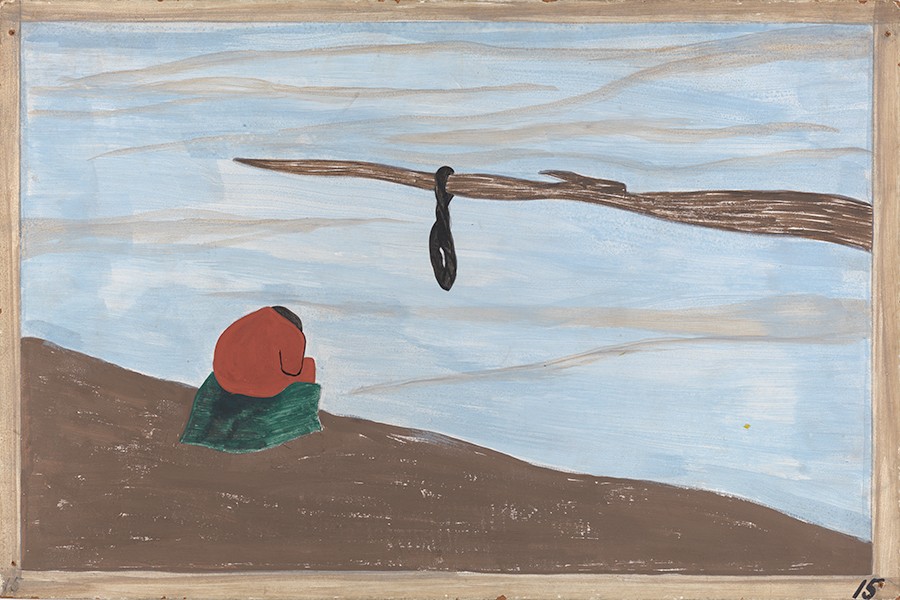
Willa Rawlins said in her Krueger-Scott interview:
My father had preceded us to Newark…My uncles felt it was better for my father to be up North because he had a hot temper and they didn’t want to see him hanging from a tree down there. Period.
Of course it wasn’t like the North provided some fully safe space for African Americans either. All things are relative in racism. In fact, the wonderful NJ Social Justice Remembrance Coalition has been working to memorialize spaces where Black Americans have been lynched in New Jersey. They recently received funding to create a marker for the spot where Samuel Johnson was lynched in Eatontown. And now they are working with The National Memorial for Peace and Justice in Montgomery, Alabama to have Mr. Johnson’s name added to the museum’s exhibit that remembers the scourge of lynching in our country. I visited this site in the summer of 2023. It is incredible, and not an easy experience. But if everyone in this country went there, somehow someway, we might not have just elected ourselves a racist-plus president. But I digress.
Another reason that Black Southerners were leaving their homes was that they simply wanted to give their children the chances in life they never had. This is a parental instinct as old as parenting. A lot of the Krueger-Scott narrators were kids when they came to Newark. The above-quoted Willa Rawlins was 4 years old when she arrived; and John B. Ross came at age 5, in 1924, from Georgia; and there was Ethel Richards who was 9 when she arrived in Newark, in 1927. Most of these narrators, at the time of their interviews, were in their 70s and 80s, yet they often had vivid memories of coming to Newark as children. This is a human trait, remembering childhood moments well when our surroundings have shifted drastically.
Another question that often arises is, How did the African Americans travel to get to their new homes? Again, there are many answers to the question. Not everyone piled their luggage on top of a car, like this iconic photo that seems to show up every time the term Great Migration appears on the internet.
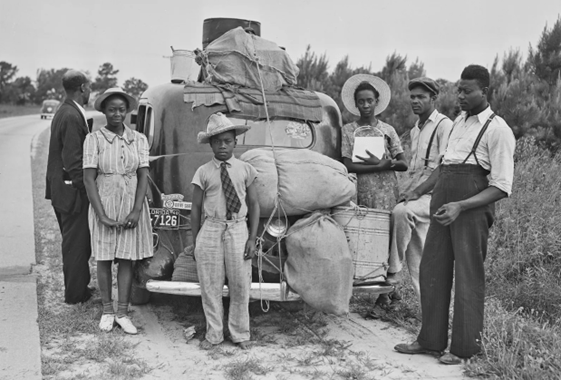
One of the most popular modes of transit was the train. There are so many stories of that train ride in my book, and such different memories of the experience. One interviewee actually remembered sitting next to Jesse Owens on her trip and you can hear the excitement in her voice as she recalls this experience, all those decades later.
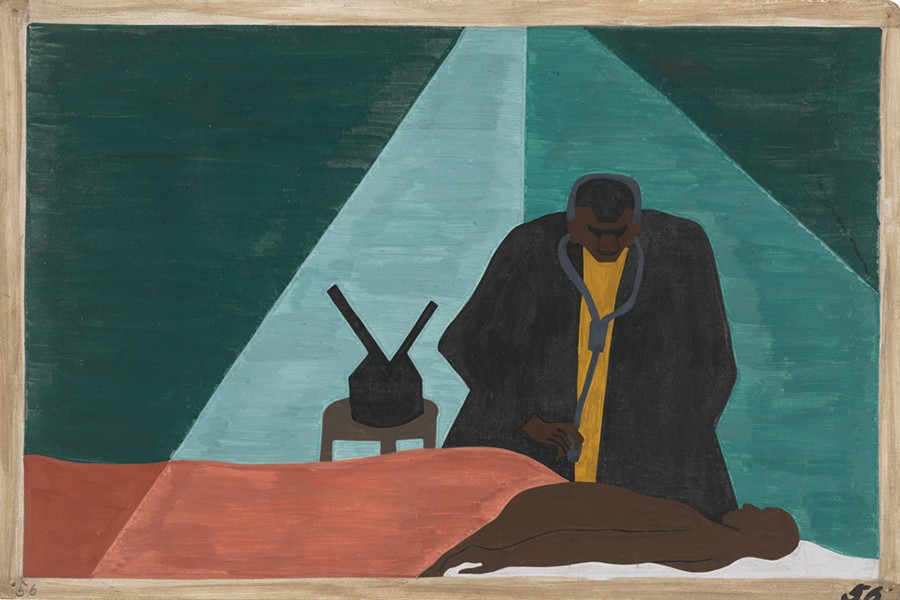
My commitment to oral history has to do with my mission to foreground the voices of people with lived historical experiences that so often are left untold. One perc of an oral history collection is that it reminds us that no one group is a monolith. This is an especially valuable reminder when it comes to African Americans and their history. In fact, one of the myths surrounding the Great Migration is that everyone who left the South was poor. In actuality, large numbers of educated, professional people were a part of this migration – and why cities like Newark – and Los Angeles — have the industries and institutions that they do. The Krueger-Scott oral histories alone feature teachers, doctors, politicians, clergy, radio personalities, musicians, activists, journalists, poets, psychologists, and law enforcement officers, amongst others. As Lawrence captions Panel #56, “The African American professionals were forced to follow their clients in order to make a living.”
At the library talk, I showed the audience how my book was organized – because it’s apparently unusual for a history book to focus on themes rather than timelines and famous people. I also shared the story of the Krueger-Scott Mansion – where the interviews were supposed to be housed in a Black cultural center. And of course, there was much more said that night, but suffice it to say the evening was a pleasure for numerous reasons. Joy raffled off my books and I signed them; others brought their books for me to personalize; there were even nice snacks. But most importantly to me, I had people comment that I was doing the right thing, doing right by these stories and their narrators. We all know what it means to have someone say they understand your work and see it as important. I drove home that night, in my son’s car that seems to beep at me incessantly, thinking that this book tour might not have been such a bad idea after all. So many of us really do want to keep on learning our history, and for that I am truly grateful.
 Katie Singer