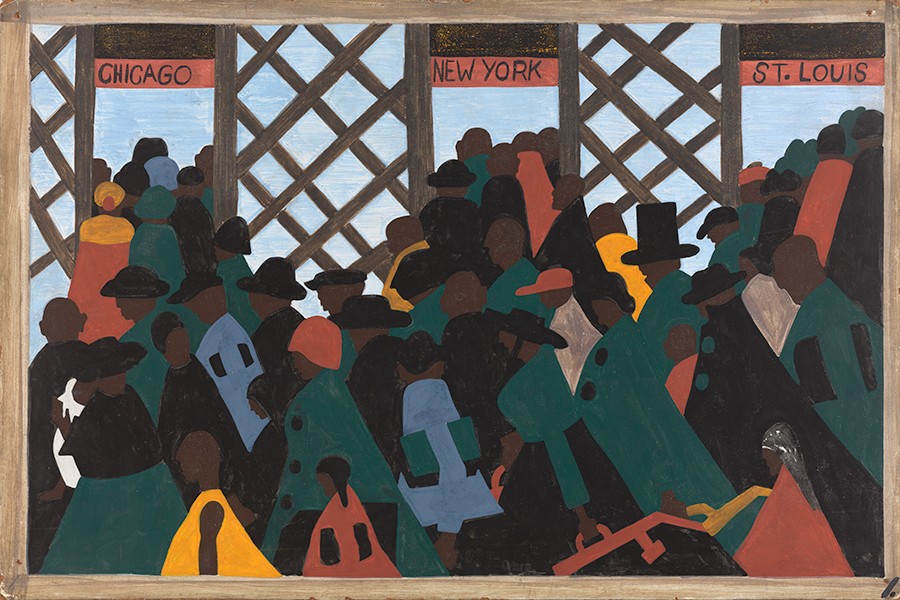
Panel 1: The Migration Series, Jacob Lawrence.
JACOB LAWRENCE WAS A JERSEY KID, and an artist whose work many of us are familiar with – even if we don’t know his name. Lawrence was born in Atlantic City, his parents a part of the Great Migration. But he moved to Harlem as a teenager and spent most of life there. And while his art deeply reflects the influence of that mid-20th-century Harlem neighborhood, one famous series of his stands out from this theme. Lawrence’s Migration Series is based upon stories he heard his family tell as he was growing up, and throughout his time in New York. These were stories of the Great Migration. And if you, too, are interested in stories of the Great Migration, well, then you can always order my book!
Lawrence’s painting above is the first of the 60-panel Migration Series. The series was completed in 1941, funded in part by the Works Progress Administration (WPA). It was to be viewed as one piece in his thinking, not 60 separate works of art, because it told one continuous story. Perhaps we can even think of each painting as a chapter in his unwritten book. Ultimately, two museums would split this collection – New York’s Museum of Modern Art (MoMA) and Washington DC’s Phillips Collection. At times they have collaborated to show this whole series together, and I was able to view one such exhibit, entitled “One-Way Ticket,” at MoMA in 2015. Every panel, by the way, includes a caption. Lawrence initially wrote these captions in the 1940s, but as language and culture (somewhat) evolved he made modifications to most all of them in 1993, prior to an upcoming exhibit of his work. Most commonly, the word “negro” was changed to “Black” or “African American.”
The commencement date of the Great Migration differs depending upon whom you ask. Many, like Lawrence, place its origins around the beginning of WWI, some calling that the First Great Migration. (The “second” would come around the time of WWII). But African Americans were certainly leaving the South for places North, East, and West way before then. For example, in Newark, New Jersey, the African-American Bethany Baptist Church was already being established in 1870, when a group met together in Deacon Jackson Watson’s home at 187 Commerce Street. The church became officially sanctioned in 1871. The need for Black churches was growing as migrants moved from the South. And Bethany Baptist continues to be central to many African-American religious lives today, even as some have moved far outside the city limits within which they first lived.
The Great Migration, as with so many migration streams, can be characterized by both pushes and pulls. Pushing Black Americans out of the South at this time was the continued and escalating violence directed at Black southerners; many whites resented the “freedoms” that they were enjoying for the first time. As well, for African Americans in the rural south – and remember, not everyone who left the south came from a farm! – agricultural disasters quite often precipitated the departure. And finally, there was the hope for a life less fettered by racism. A hope that some felt was dashed, while others discovered was well worth the trip. As former mayor Sharpe James said towards the end of his Krueger-Scott interview:
Newark has given me everything, and the only thing I want to do is give something back to the city that took this poor boy who was a transient from the south, gave him hope, gave him love, kept him alive, gave him an education.
The period around WWI saw a lot happening in this country, and participants of the Great Migration were key to many of these events, directly and indirectly. For example, George Baker, known as Father Divine and the self-proclaimed God incarnate, was from the South — North Carolina or Maryland, depending upon what records one reviews. Divine started the multiracial International Peace Mission Movement sometime around 1915 in the Brooklyn, New York area, and ended up becoming one of the most revered and followed religious leaders of the time period. So much so that many would even call his organization a cult. There is plenty of discussion about Divine by the narrators in my book — from the live radio shows he recorded, to the lavish, yet extremely cheap, meals he would host at the Riviera Hotel.
In April 1935, the Newark Evening News described a banquet attended by Father Divine where there were “baskets of fruit and candy everywhere. More than 500 men, women and children were seated at the table and at least that many stood around the perimeter. From the audience a woman shouted, ‘Oh father, our Saviour, I love you.’ Father Divine sat in a satin-backed chair at the head of the banquet table. Every course passed through his hands.”
For Father Divine, leaving the South meant reinventing himself. He chose to leave his past behind so intentionally that very little is known of his family or birthplace. Although he died in 1965, Divine’s followers still participate in some of the Mission’s proscribed rituals today, carrying on his traditions and ideology throughout this country. Recent pieces in mainstream papers and journals can attest to this fact.
In terms of work at this time, studies show that prior to 1917 approximately 75% of African Americans in the country were “gainfully employed, mostly in domestic and ‘personal service’ jobs.” The war provided many of them a chance to leave these sorts of jobs, to work in factories and shipyards and earn more money than ever before. (Yet not typically equal to what the white laborers were making). But as would happen again post-World War II, after World War I when the white soldiers returned home to work, suddenly the recently hired Black laborers (and women, for that matter) were deemed no longer competent or capable to remain in those positions. “Last hired, first fired” would be the employment model for many a decade to come.
So there will be more on labor shortages, the influx of Black workers, and the changing landscape of U.S. cities in the early 20th century in next week’s blog. Until then, let’s keep learning our history!
 Katie Singer